

A tablet of Covid-19 vaccine from pharmaceutical giant Pfizer contains 975 doses – far too many for a rural Arkansas hospital.
Given the logistical gymnastics required to safely get the Pfizer vaccine to rural health workers, breaking the trays into smaller shipments has its own dangers. Once the vaccine comes out of the freezer, which keeps it at 94 degrees below zero, it only lasts for five days and needs to be refrigerated during transport.
Full coverage of the coronavirus outbreak
In Arkansas – where over 40 percent of the counties are rural and the number of Covid-19 infections is rising – solving this distribution puzzle is urgently needed, said Dr. Jennifer Dillaha, the state’s epidemiologist.
“If their providers get along with Covid-19,” said Dillaha, “there is no one there to take care of the patients.”
Such issues are resonating with officials in Georgia, Kentucky, Utah, Indiana, Wisconsin, and Colorado. The initial impetus for mass vaccination efforts against Covid-19 was chaotic, characterized by a lack of guidance and misunderstandings at the federal level.
connected
Since Washington makes most of the vaccination decisions, each state and county must weigh up where to send vaccines first. Which of the two emergency vaccines approved by the Food and Drug Administration is for any nursing home, hospital, local health department, and most useful even school. And after months of warnings by state officials that they lacked the resources to distribute vaccines, the Centers for Disease Control and Prevention will only now receive a significant boost in funding – $ 8.75 billion in the latest Congressional Aid bill passed by the Legislators will likely pass this week.
Claire Hannan, executive director of the Association of Immunization Managers, said the performance that public health officials are facing has “absolutely no comparison” in recent history.
Officials who thought the 2009 H1N1 swine flu shot was a logistical nightmare say it now looks simple in comparison. “It was a flu vaccine. It was a dose. It came at temperatures that were stable in the fridge, ”said Hannan. “It was nothing like that.”
In a matter of days, the logistical barriers of the vaccine manufactured by Pfizer and BioNTech were exposed. Many officials are now pinning their hopes on Moderna, whose vaccine comes in 100-dose containers, does not need to be frozen and has a shelf life of 30 days from dispatch.
The federal government had distributed nearly 8 million doses of Pfizer and Moderna vaccines this week, in addition to around 3 million Pfizer shots sent out last week, Army General Gustave Perna, chief operating officer of Operation Warp of the Trump Administration Speed Effort, said.
Perna said he took “personal responsibility” for overestimating how many doses of Pfizer states would receive.
Federal delays have created confusion, Dillaha said, “Sometimes we have information from CDC or Operation Warp Speed before a decision has to be made.”
Officials in other states have painted a mixed picture of the rollout.
The Georgia Coastal Health District, which oversees public health in eight counties and has offices in Savannah and Brunswick, spent more than $ 27,000 on two ultra-cold freezers on the Pfizer vaccine, which it treats “like gold,” said Dr. Lawton Davis Director of Health. Healthcare workers are asked to travel up to 40 minutes to get their vaccinations, as shipping would risk them wasting doses, he said. The vaccination was less than Davis would like to see. “It’s kind of a puzzle and a balancing act,” he said. “We learn as we go.”
connected
In Utah, sites where teachers and first responders could be vaccinated from January onwards had no way of keeping the Pfizer vaccine, despite officials trying to secure ultra-cold storage, a health department spokesman said. Very few of Kentucky’s local health offices were able to retain the Pfizer recordings due to refrigeration needs and the size of the shipments, said Sara Jo Best, director of public health for the Lincoln Trail District. The Indiana Health Department needed to identify alternative cooling options for 17 hospitals following changes to vaccine thermo transmitter guidelines.
And in New Hampshire, where the National Guard will help administer vaccines, officials last week finalized details for 13 community locations to be vaccinated for first responders and healthcare workers later this month. Jake Leon, a spokesman for state health and welfare, said that while the sites can deliver both companies’ vaccines, they will most likely receive modernas because transportation is easier. Even when the earliest vaccines are injected, a lot remains in the air.
“It’s day after day and even then hour by hour or minute by minute – what we know and how we plan it,” said Leon on Friday. “We build the plane while we fly it.”
In total, the Trump administration has bought 900 million doses of Covid-19 vaccine from six companies, but most vaccines are still in clinical trials. Even the front-runners whose footage received FDA emergency clearances – Pfizer and BioNTech on December 11th, Moderna on December 18th – will take months to manufacture on this scale. The Trump administration plans to distribute 20 million doses of vaccine to states by early January, Perna said on Saturday.
By spring, officials hope to see broader vaccine use beyond the priority populations of healthcare workers, residents and nursing home workers, and first aiders.
During the effort to vaccinate Americans against H1N1, health departments in their counties set up mass vaccination clinics and supplied schools with doses. However, hospitals are taking responsibility for parts of the first vaccination campaign against Covid-19, both because health workers are at the highest risk of illness or death due to Covid-19, and to fill the void in health departments that is affected by case studies and Contact tracing are overwhelmed by an endless stream of new infections.
Best said her workforce is struggling to keep up with Covid-19 infections, much less flu season, and upcoming Covid-19 vaccinations alone. The Kentucky health department’s workforce shrank 49 percent from 2009 to 2019. Across the country, 38,000 state and local health positions have disappeared since the 2008 recession. Per capita spending on local health departments has fallen by 18 percent since 2010.
Nationwide, Pfizer and Moderna have signed contracts with the federal government to each provide 100 million vaccine doses by the end of March. Moderna is expected to deliver a second tranche of 100 million cans by June. The states played it safe last week and directed Pfizer vials mostly to facilities with ultra-cold freezers, Hannan said.
“Much of this vaccine is for institutional use,” said Sean Dickson, director of health policy at West Health Policy Center, of the Pfizer recordings. The center with the University of Pittsburgh’s School of Pharmacy found that 35 percent of the counties have two or fewer facilities for administering Covid-19 vaccines.
connected
The analysis revealed huge differences in how far people would have to drive for the vaccine. North Dakota, South Dakota, Montana, Wyoming, Nebraska, and Kansas residents face the longest journeys. More than 10 percent live more than 10 miles from the nearest facility where a shot could be fired.
Districts with long journeys between sites and a low number of sites overall “will be the hardest to reach,” said Inmaculada Hernandez, assistant professor at the University of Pittsburgh’s School of Pharmacy and lead author of the analysis.
Certain vaccines could be better suited for such locations, including the potential Johnson & Johnson offering which is a single shot and the health departments could be distributed through mobile units in rural areas, she said. The company is expected to file for emergency FDA approval in February, Moncef Slaoui, chief scientific advisor to Operation Warp Speed, said this month.
Until then, Pfizer and Moderna will be the supplying doses for the country and they will not be considered the same, even though both are more than 90 percent effective at reducing disease.
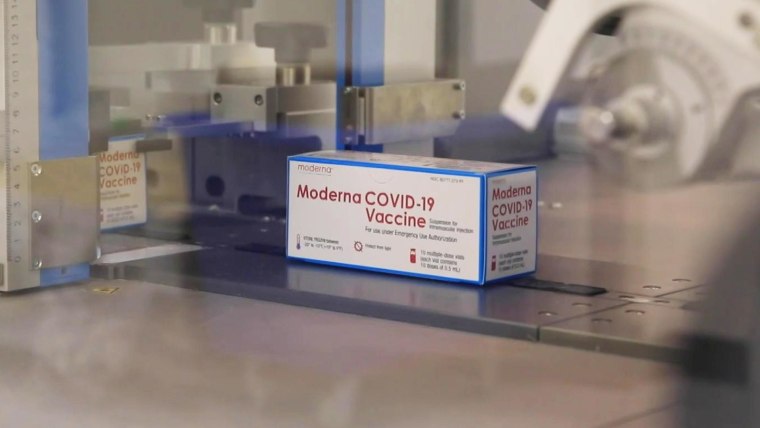
In Wisconsin, the Moderna vaccine “gives us a lot more options” and “enables us to get doses for these smaller clinics, more rural clinics, in a way that requires less logistics for ultra-cold storage,” Dr. Stephanie Schauer, the manager of the state vaccination program, told reporters on Wednesday.
Alan Morgan, director of the National Rural Health Association, reiterated that the Moderna vaccine was seen as a “rural solution”. But he said states like Kansas have shown a rural rollout can be done by Pfizer.
Download the NBC News App for full coverage of the coronavirus outbreak
“This is where these states give priority – either they go into rural areas or they don’t,” he said. “It’s a cautionary story about what we’ll see this spring that rural populations may be secondary to vaccination.”
Virginia also has a plan to get the Pfizer vaccine to distant places. The vaccines will be delivered to 18 health facilities with ultra-cold freezers across the state. The hubs are spread out enough that vaccines can get shots from there to health workers before they spoil, even in sparsely populated areas, said Brookie Crawford, spokeswoman for the central region for the Virginia Department of Health.
In Washington, however, hospitals without ultra-cold freezers can temporarily store Pfizer vaccines in the thermal boxes they arrive in, said Franji Mayes, spokesman for the state health department. That means a box needs to be used quickly before the cans expire.
“We’re also working on a policy that will allow hospitals that don’t expect to vaccinate 975 people to transfer additional vaccines to other enrolled facilities,” she said. “This will reduce vaccine waste.”
KHN (Kaiser Health News) is a non-profit health news service. It is an editorially independent program of the KFF (Kaiser Family Foundation) that is not affiliated with Kaiser Permanente.
Follow NBC HEALTH on Twitter & Facebook.

Comments are closed, but trackbacks and pingbacks are open.