

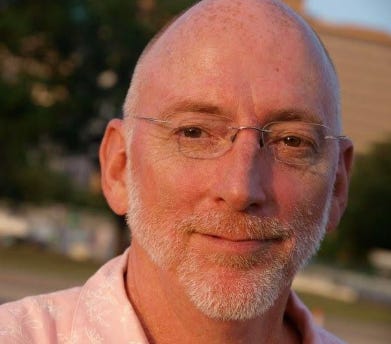
As Walter Benson Jr., 103, walked out of Lions Municipal Golf Course on a sunny November day, he imagined Walter Rein, 7, carrying a golf bag almost as big as himself.
“We both have the same name,” said the elder Walter. “And I was exactly your age when my dad brought me here to see Muny for the first time while it was being built.”
Your math is correct: that was in 1924.
For more than a century, the Austinites have known Benson as many things. Among them: adventurous youth, WWII veteran, school book publisher, thoroughbred breeder, and polished ballroom dancer.
Still, it was his legendary game of golf that stayed with Benson for much of his life.
In 1899, his father, Walter Benson Sr., was a member of the Austin Country Club’s charter committee when it was at the Hancock Golf Course on Red River Street. Benson later cadded for his father and learned the game by his side.
He was an excellent player on the Austin High School golf team. Later at the University of Texas he was a student of the legendary Harvey Penick and won several amateur championships. Hole 3 in Muny is named after Benson.
In fact, Penick wrote a personal copy of his bestselling book, Harvey Penick’s Little Red Book: Lessons and Lessons from a Life in Golf, written with Bud Shrake, with the following note, including a reference to Houston-born Jimmy Demaret, a professional golfer who Won 31 PGA Tour events, including three wins at the Masters, with titles in 1940, 1947 and 1950:
07/15/92. Walter Benson, whose club I have enjoyed for many years: since a little boy: Jimmy Demaret also said to me: ‘Best golfer in Texas!’ I hope you enjoy this book. I have many fond memories of our club. Sincerely, Harvey Penick. “
A boy from Austin
Walter S. Benson Jr. was born in Austin on October 24, 1917 to Florence Brownlee Benson and Walter S. Benson Sr.
“Dad was working for Wells Fargo in Mexico City when it was an express company, not a bank,” says Benson, whose paternal grandparents were schoolteachers. In the 1930s, Benson’s father and brother Matt Benson joined forces in a dual business at 109 E. Fifth St. – WS Benson & Co., a publisher, and Benson Motor Co., a dealer that sold Studebakers.
A mural on the side of this handsome, arched building still says “Benson Motor Co.”
Benson’s mother’s people were from Burnet. He grew up with a half sister, Winifred, and a full sister, Florence. His father named Winflo Drive in Old West Austin after his daughters.
“It was a subdivision of the old Nalle property,” says Benson. “My father bought it from the Nalles.”
This particular Nalle mansion – there was more than one for the still prominent family – stood east of the surviving Flower Hill residence in West Sixth, which now houses a municipal homestead museum. The Benson family lived on Castle Hill on West 12th Street, later in 1504 West Lynn, in a simple two-story house that still stands.
He attended Pease Elementary – “when TA Brown was headmaster” – and then Allan Junior High when it was housed in an imposing red-brick building that burned down in 1956 on East Ninth and Trinity Streets. After 11th grade, he graduated from Austin High in 1934.
“They didn’t have 12 grades,” says Benson. “Only 11.”
Benson describes himself as a good, but not exceptional, student who sought adventure with boys his age.
Your stories live here.
Fuel your hometown’s passion and immerse yourself in the stories that define it.
Create an account
“I bought a Model T Ford for $ 25,” he says. “I modified it to turn it into a racing driver. I called it the ‘miracle ride’. “
In the summers of 1934-1936, Benson attended summer school at Culver Military Academy in Indiana for cavalry training. However, by the time he signed up for service during World War II, the American military had virtually given up mounted soldiers. However, Benson never lost his love of horses and takes care of two on a small farm in the coppice south of Austin.
In high school, Benson was “too slim” for soccer, but just right for golf.
“I liked the competition and the outdoors,” Benson says of the sport. “Harvey Penick was the pro at the country club when I was young and he also coached the UT golf team.”
Benson studied business administration and electrical engineering at UT. Then, when World War II came, he trained to repair important airplane radios. After further military training, the second lieutenant was stationed at Bassingbourn Air Base near Cambridge, Great Britain
“I saw General Eisenhower shortly before the Normandy invasion,” Benson recalls. “It came through corporate headquarters. He was so respected. “
While his shifts fixing radios kept him busy during the war, he had his share of the fun on vacation. He and his friends rode their bikes to local dances within a 30 mile radius of the base. He also played the St. Andrews Golf Course in Scotland, which is considered the oldest in the world and the ultimate destination for any golfer. He also played at the Gog Magog Golf Club, a course outside of Cambridge named after the biblical giants.
He left the service in 1945 as the captain of Davis Mountain Air Base in Tucson, Arizona.
That same year he met his wife, Frances Bird Bolton, in Austin when he was finishing his engineering degree. From Jacksonville, Texas, Bolton was visiting a friend in Austin when they first met. They had two children: Barbara Bolton Benson and Walter S. Benson III. Frances Bird Bolton died in 2005.
Make a life of it
Despite studying engineering at Westinghouse Electric in Pittsburgh, Benson returned to Austin to run and ultimately take over his father’s textbook publishing business.
“In 1908, my father represented Anna Pennybacker,” he says, “and received her” A History of Texas for Schools “through the State Board of Education.”
Since Texas is one of the few states where children are required to study the history of the state – only seventh grade for a long time and fourth grade since the 1960s – this type of contract meant the family business remained profitable. During his tenure, Benson Jr. managed to obtain several more modern Texan history books.
Benson, who reads my Think, Texas column and was interviewed some distance through masks on his girlfriend’s spreading deck in the Balcones neighborhood, proudly presented me with copies of three of his modern Texan history books. He kept his copy of the 1908 Pennybacker, which is a collector’s item.
By the way, Anna Pennybacker was a teacher, public speaker, and suffragist whose first book on the history of Texas came out in 1888. Austin’s Pennybacker Bridge over Lake Austin, located next to the current Austin Country Club location, is named for her son, engineer and early bridge builder for the Texas Highway Department, Percy Pennybacker Jr.
Benson also raised racehorses.
“After getting up in my 70s, I started spending more time on the horse farm,” he says. “In the 1980s, we got parimutuel betting passed under Texan law. I was the third official member of the Texas Thoroughbred Breeders Association. My uncle ran a ranch between Burnet and Marble Falls and raised thoroughbreds. That’s how I got into the breeding industry. “
Benson’s horses have won more than 50 races.
Another of his passions was dance.
“Oh my god, he was so lithe and quick,” says widowed friend Nancy Wilson. “Everyone said it. We went to the High Ball in South Lamar every Monday night when they had an amazing big band, Republic of Texas with all the horns. “
The long game
Benson won the Austin City Championship twice, the Firecracker Invitational twice, and the Harvey Penick Invitational twice. He was known for powerful drives, not for overly accurate putting.
“I modeled my game on Ed White, who won the National Intercollegiate Championship before World War II,” says Benson. “So I focused on the long game instead of the short one. I was lucky enough to win the tournaments that I did. “
When asked about specific golf courses, Benson doesn’t start with long stories of golf’s past, but sticks with the most compelling memories.
“St. Andrews is difficult because of its location by the sea, ”he says. “The wind was blowing strong.”
Some of his memories take him back to the first of three Austin Country Club locations, when the first nine were on the current Hancock Golf Course and the last nine were created where the Hancock Center retail complex now rises.
“Jimmy Demaret came from Houston and shot a 60 to set a course record,” recalls Benson. “That is 10 below average. I think I shot a 72 that day. My lowest score was 63. “
He describes how golfers went from the top nine to the back nine, a puzzle this reporter has been trying to solve for decades.
“You got to the corner of the lot and shot the ball down Red River Street,” he says with a laugh.
Benson thought the second country club on Riverside Drive was an excellent place.
“There were some sand traps missing,” he says. “You never got around to it.”
His favorite course was the Colonial Country Club in Fort Worth.
“The first tournament there was an amateur match play,” he says. “In the morning I played 19 holes against ‘Shorty’ Long because there was an additional tie-breaker hole. In the afternoon I played 21 holes against Don Schumacher.
“I was an unknown player and the local headline read: ‘Murderer hits town!'”

Comments are closed, but trackbacks and pingbacks are open.